



Imagine you’re a wallflower with improbably deep affection for Homer’s classic maritime misadventure The Odyssey and you’ve just learned Christopher Nolan will direct a feature film adaptation, sailing into theaters this summer.
You tremble with anticipation, and a little dread. You’ve seen a few Nolan movies and noticed his tendency to deprioritize meaningful conversations in favor of loud orchestral hits (BWAAAAAAM) and guns firing backwards. You’ve heard Matt Damon will play Odysseus, despite the fact that Oscar Isaac exists.
What evidence of cinematic discernment could soothe your mounting anxieties? What scene, deftly handled, could persuade you the director held your beloved tenderly?
For us, it’s a no-brainer. Book XIX: Odysseus returns to Ithaca and speaks to his wife Penelope for the first time in twenty years… in disguise.
This mythic power couple’s fraught exchange of half-truths exemplifies all that’s most delightful about The Odyssey: danger, subtlety, and… well, thirst.
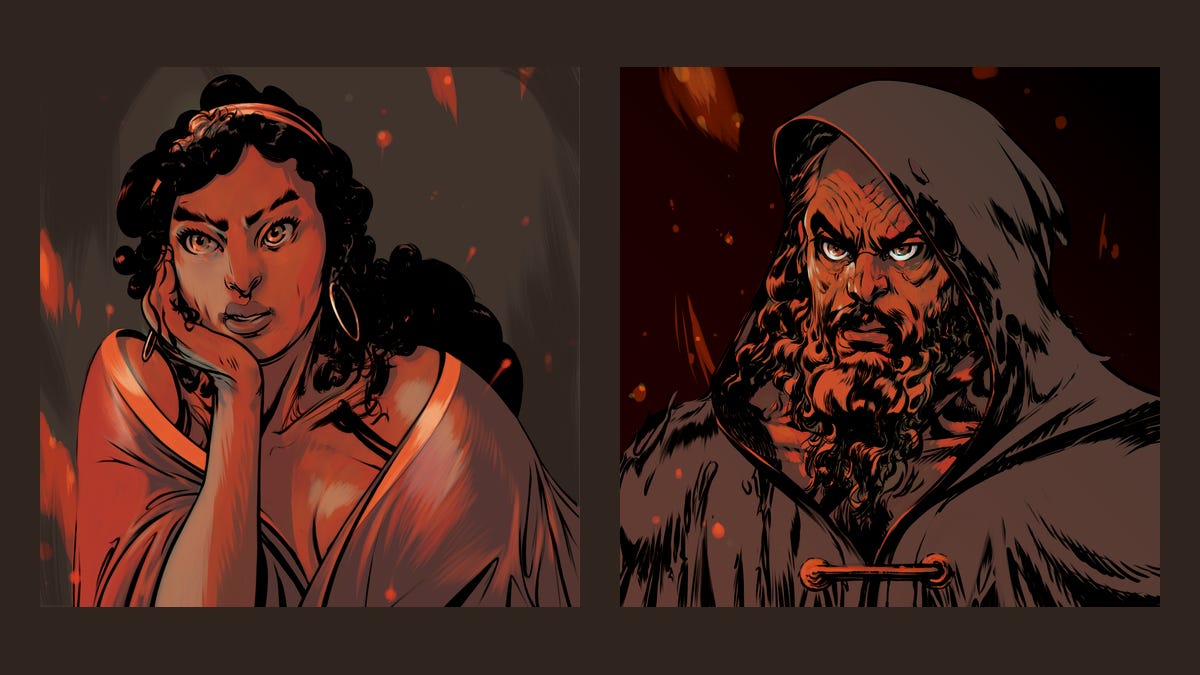
We love the scene’s ambiguous tension so much, we built a game around it, loosely based on dialogue from Robert Fagles’ 1997 translation.
A deadly power struggle? High-stakes foreplay?
Odysseus returns home to a life-or-death situation: men who want him dead have overrun his house, openly competing for his wife’s hand in marriage. Survival depends on surprise.
But does Penelope want him to survive? He’s been gone for twenty years — plenty of time for her to grow accustomed to the throne and its privileges. Are these lovers allies or enemies? Neither knows for sure, so they play a delicate game, each trying to discern the other’s intentions without revealing their own.
It’s role play with lethal stakes, charged with delicious uncertainty.
Our take
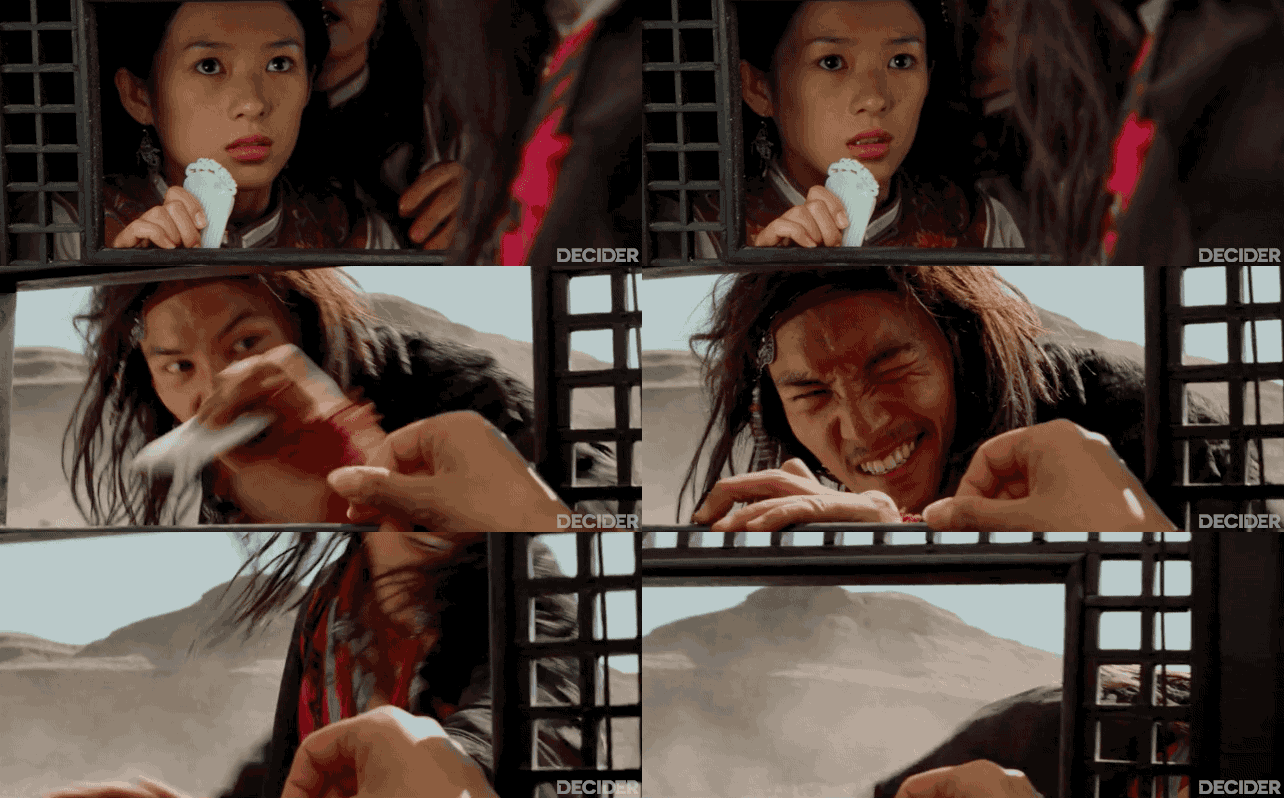
Penelope and Her Guest is a short and spicy interactive fanfic in which the long-separated king and queen reunite for a deadly game of wits. Think Glass meets Star Crossed meets that unbelievably sexy horseback fight in Crouching Tiger Hidden Dragon.
It works like a choose-your-own-adventure story, but instead of choosing what happens, the player decides what they believe.
Are Penelope and Odysseus competing for power? Are they rehashing decades-old insecurities? Have they just unlocked a new kink? It’s up to the player, and all interpretations are valid.
How it works
We like games that tell stories about complicated relationships. With this project, we wanted to explore how it would feel to see someone we loved after twenty years apart. Even if they weren’t in disguise, would we recognize them? If we did, what kind of grief, anger, or relief might pass through us? What if they arrived during an intense political conflict, and we didn’t know whether they were on our side? We wanted our game mechanics to heighten this sense of danger.
The system we landed on is pretty simple. We track three integers: Love, Doubt, and Fear. Most choices affect one of these variables, and after each move, the leading value determines which conditional text players will see. This is usually a story beat (a memory, a train of thought, or a detail the character notices) reinforcing that emotional lens.
For example, if Fear leads, Odysseus might wonder about Penelope’s uses for the “beefcake” suitors sleeping in the hall. If Love leads, he might admire her skill at deceiving them.
Our goal here was to replicate a tendency we’ve noticed in ourselves during difficult conversations: early judgments (whether positive or negative) tend to self-reinforce.
But when we started playtesting, we realized that on its own, this mechanic deflated the tension. It propelled the story down a single path, determined at the outset. Since we wanted to keep players on their toes, we needed to revise our game logic.
Let’s get volatile
We started by tracking “streaks”: the number of times a player chooses the same integer in a row. This opened the door for three new mechanics:
Two in a row = new temporary leader — Say the player has made seven choices, all increasing Love by 1. At this point, Love = 7, Doubt = 0, and Fear = 0, and the player has only seen conditional content dependent on Love. But now let’s say that in their next two moves, the player chooses Fear. In this case, even though Love = 7, Doubt = 0, and Fear = 2, the player will see conditional text revealed by Fear. If they break the streak by choosing Love or Doubt in the next move, Love resumes its place as the leader. But if the player continues the streak…
Three in a row = new leader — …Fear’s value jumps to 8 (Love + 1) making it the new leader, and the player will continue to see conditional text based on Fear. This makes it much easier to swing between emotions during the story: even if the player has chosen Love twenty times in a row, a two-move streak can allow Doubt or Fear to reassert itself. But we still needed a chaos element…
Three different choices in three moves = Doubt becomes the leader — Generally, the more we pivot between interpretations of a situation, the less certain we feel about any of them. Our final rule reflects this dynamic: say our player who chose Love seven times next chooses Doubt and then Fear. In this situation, Love stays at 7, Fear climbs to 1, and Doubt jumps to 8, becoming the new leader.
Masters of craft
Throughout The Odyssey, Homer repeatedly characterizes Odysseus as a wily trickster who relies on intelligence and guile to escape difficult situations. It makes sense that Athena, the goddess of wisdom, takes a liking to this guy: his survival depends on a remarkable ability to perceive others’ desires and act on the insight. But when he finally makes it home to Ithaca, Odysseus meets his match in his own wife.
How’s that for romance?
Play Penelope & Her Guest
This scene continues to fascinate us after dozens of rereads, and we had a blast adapting it into our first game.
If you’re interested in trying it out, you can play Penelope and Her Guest for free on Itch.io. We’d love to hear how you read the characters… and whether you trust them.